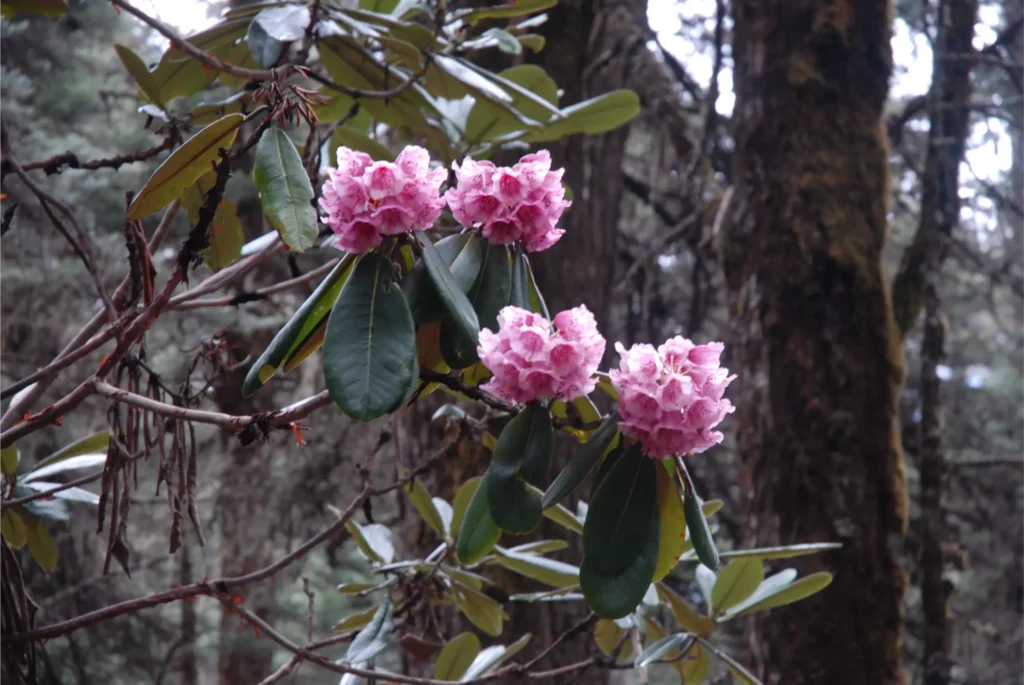
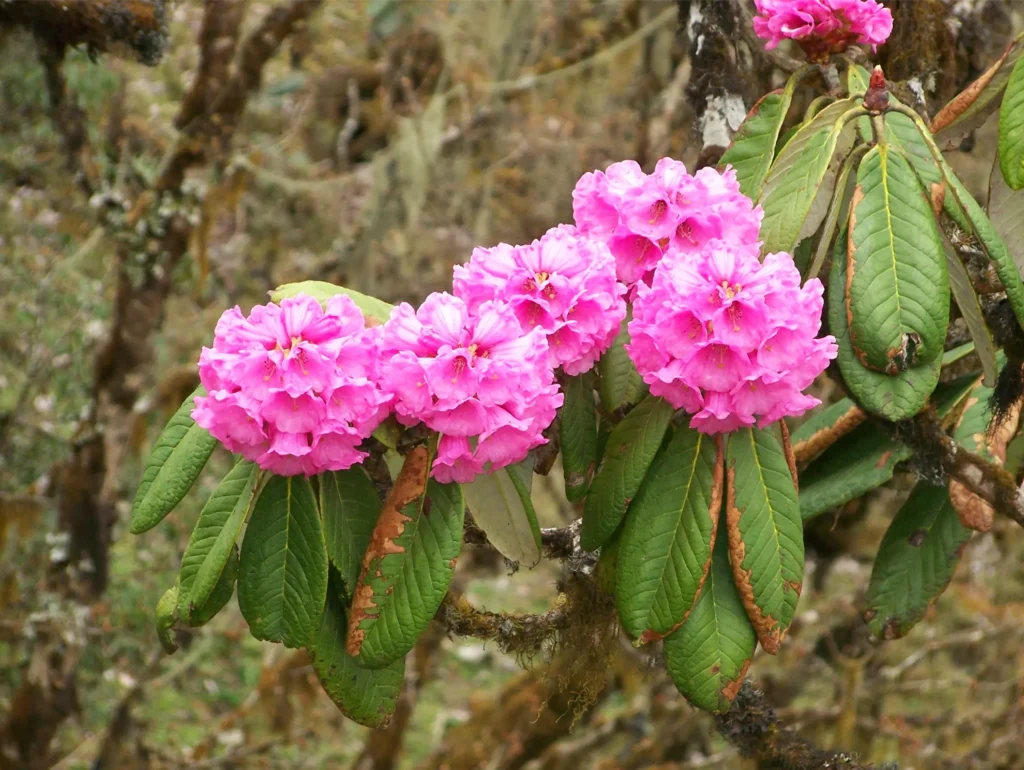
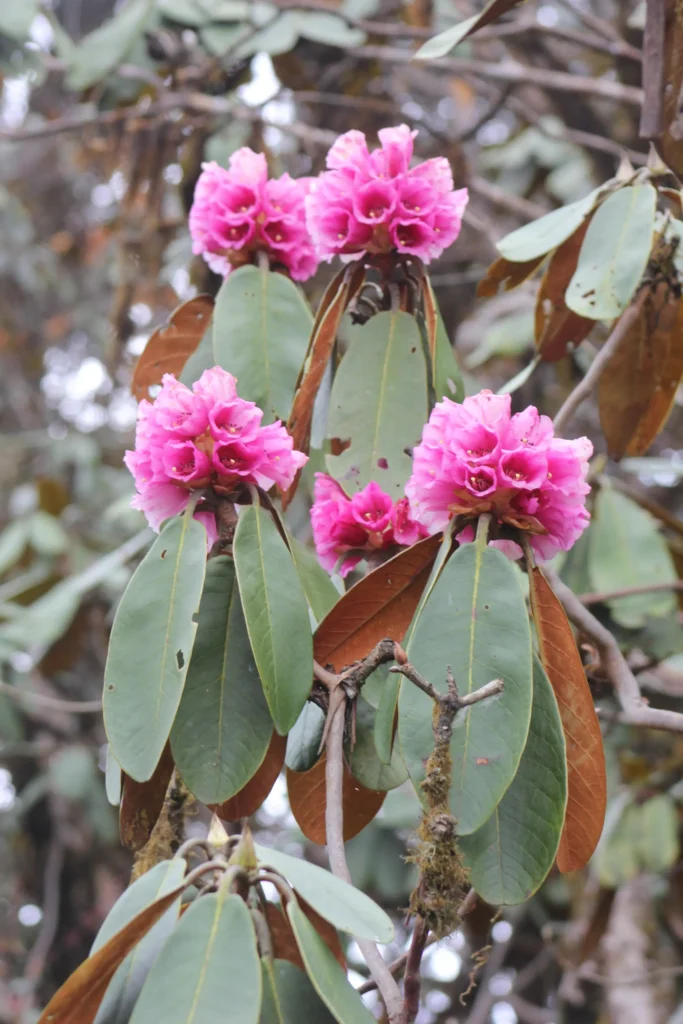
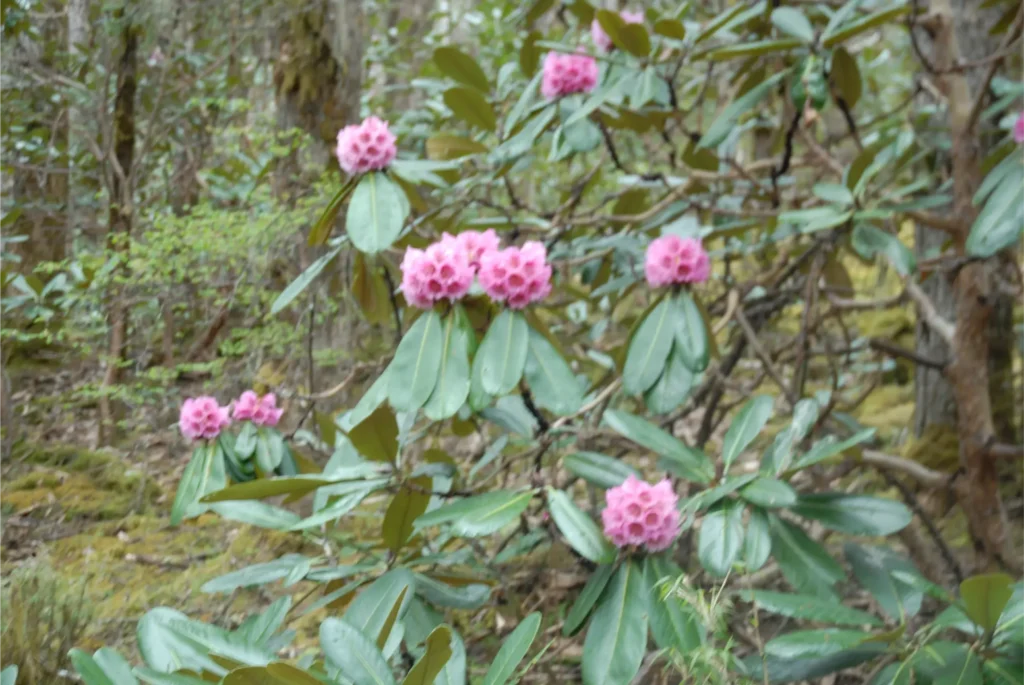
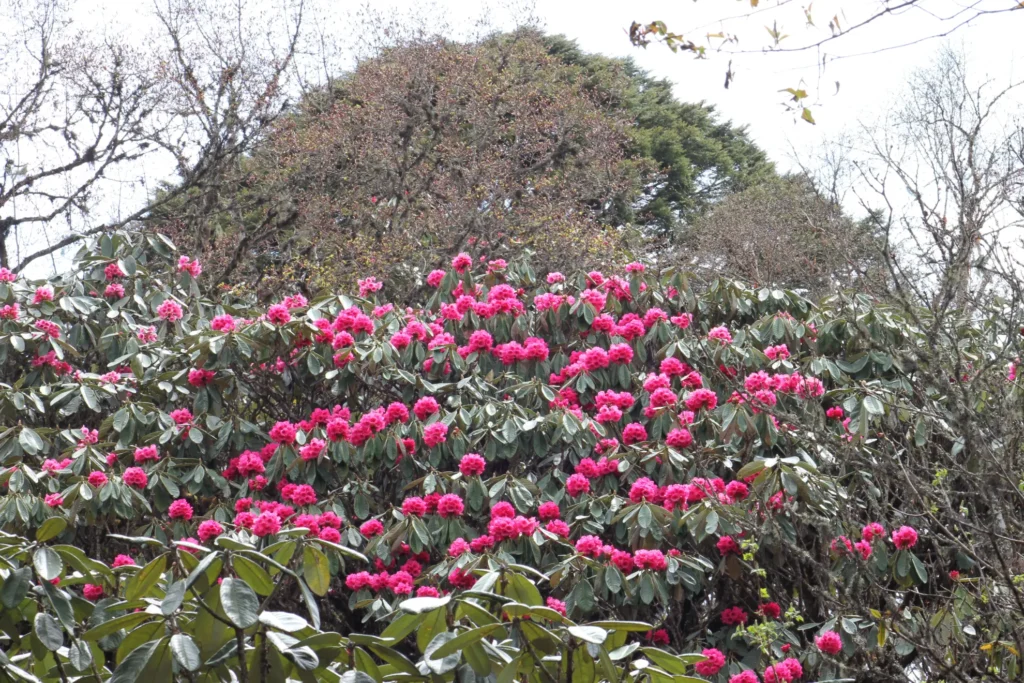
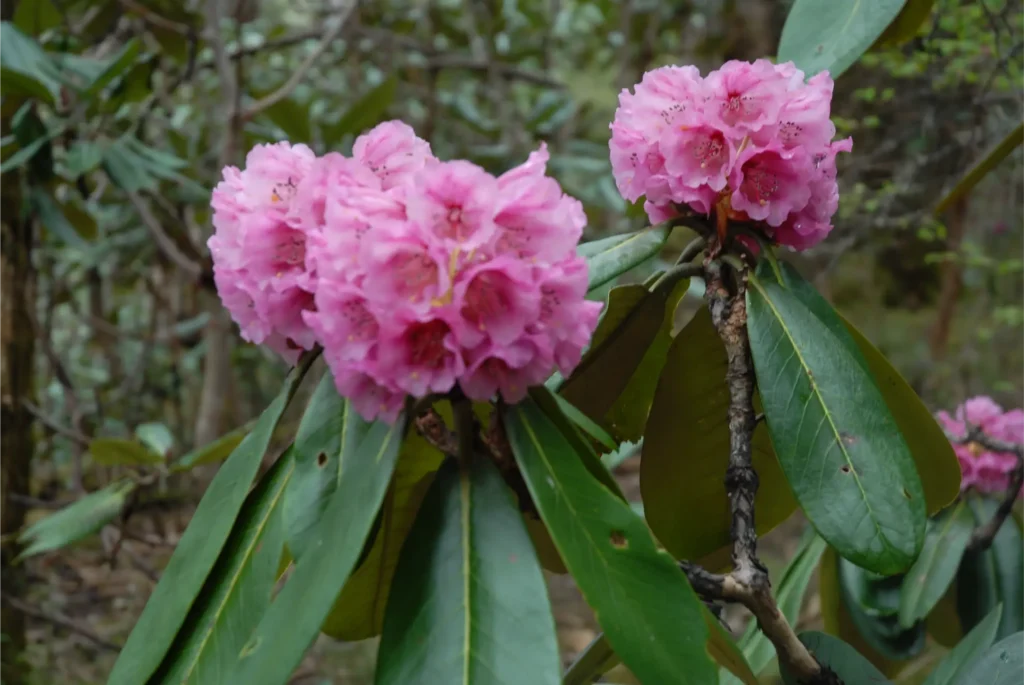
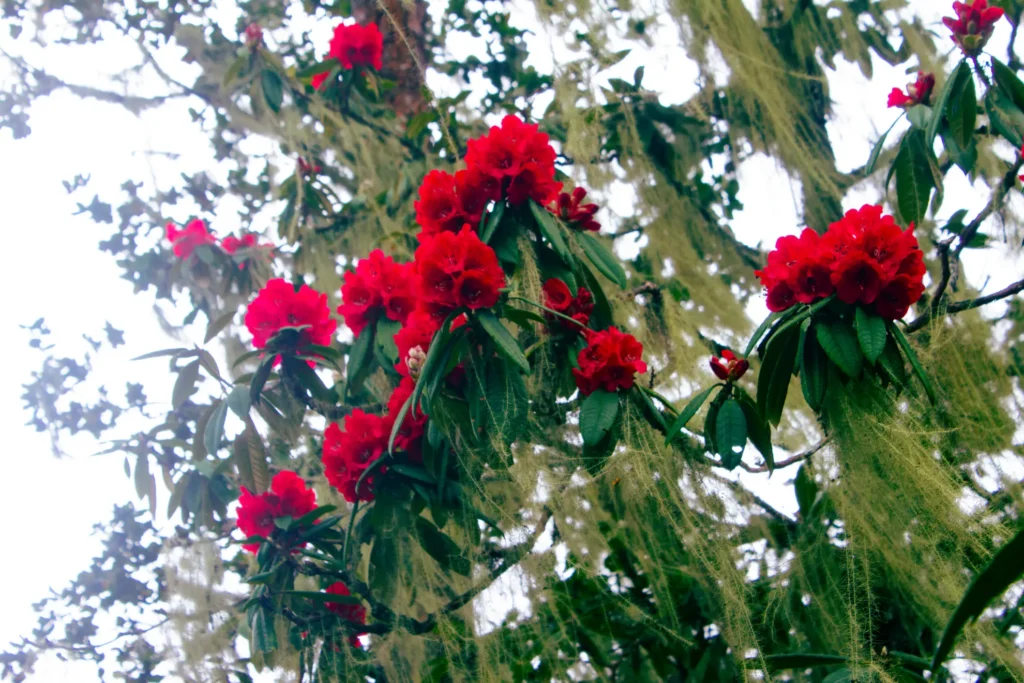
Bhutan has 48 species of Rhododendrons found worldwide. Growing at an altitude between 1,200m to 4,800m, the species blanket the alpine region of Bhutan in spring decorating the high mountain passes in a riot of colors. Of the 48 known species, six are endemic to Bhutan – R. pogonophyllum, R. bhutanense, R. flinckii, R. khochiivar, R.hodgsonii; and R kesangiae.
Day 1: Arrive at Paro
Fly into Paro, a beautiful valley which is an apt introduction to this charming kingdom. Meet your tour guide, and drive along the beautiful road which follows Paro Chhu river bank to Thimphu, the capital city. Along the way, see the Tachog Temple and see an iron chain bridge built in the 14th century. Take a stroll in Thimphu farmers market in the afternoon.
Day 2: Thimphu
We see the attractions in and around Thimphu. Our first visit is the Buddha statue, the world’s biggest, at Kuenselphodrang, the place which also affords a nice overview of the city. From here, we move to the Takin Reserve and then to Sangaygang from where we get another perfect view of the sprawling city. We also visit the Textile Academy, the Art Academy, Memorial Stupa, the magnificent Trashi Chhodzong and the Parliament building.
Day 3: Thimphu-Punakha
We drive to the ancient capital at Punakha. Our route follows the famous olden day pass at Dochula (3,050m), a vantage point from where we get stunning view of the awe-inspiring Himalayan peaks. At Dochula see R. arboretum, R. kesangae, R. falconerii and Magnolia cambelii. A short drive down, we reach Lamperi Botanical Park where, in the course of a short walk, we will see 29 species of rhododendrons besides a plethora of other plant species. Hereon, we drive downhill, leaving the temperate and alpine zone, to the sub-tropical valleys of Wangdue and Punakha where we come across the “Temple of Fertility” at Lobesa and the gilded castle-fortress of Punakha, touted as the showpiece of Bhutanese architecture.
Day 4: Phobjikha
We climb to the glacial valley of Phobjikha (3,500m.) popularly known for the winter crane habitat. The iconic Gangtey Monastery, the seat of the revered Peling Branch of Vajrayana Buddhism, is located atop a mound here. On the way at Nobding, we stop to see R. lindleyii and R. grande while still further up towards Lawala, we will find R. falconeri in full bloom. Also in the vicinity, we will find an entire forest of R. thomsonii along with other species species like R.cinnabarinum and R. keysii. As we enter Phobjikha valley, we will be able to R. virgatum and R.ciliatum, some R.thomsonii, in red and white flowers.
Day 5: Phobjikha-Bumthang Ura
We enter the heartland of medieval power and spirituality. As we gently ascend through sub-tropical forests to the temperate and alpine belts, we reach our highest point at Pelele pass ((3,140m) from where we see the Black Mountain range. From there, the gradual descent takes us to Chendebji Stupa and then to the massive Trongsa Trong, the biggest, built without using a single nail, and the traditional stronghold of Bhutan’s kings. Further up is the “Watch Tower” which is now designated as the “Museum of Bhutan’s Kings”. From here, we climb to Yotongla Pass (3,551m) and then drive downhill into the sprawling Bumthang valley. Along the high passes, we will come across R. glaucophyllum and a few other species.
Day 6: Ura-Phrusmengla-Ura
Today, we will be on a day excursion visiting the real habitat of rhododendrons. We drive uphill to Phrumsengla pass (3,750m) where we can feast our eyes on some 15 species of rhododendrons growing together in the wild. But our real treat is the visit to the Phrumsengla Rhododendron garden. The garden has more than 20 species of rhododendron preserved like in the wild, besides numerous species of plants. The garden falls within the premises of Phrumsengla National Park which is renowned for innumerable plant (nearly 650 species, including 152 medicinal plants) and animal species.
Day 7: Ura- Chamkhar
Today, we spend our time exploring Bumthang valley, the spiritual heartland of Bhutan. It is a region steeped in incredibly absorbing history, myths and legends. Enroute visit to the Mebar_tsho,the burning lake. We visit the “Castle of White Bird” or Jakar Dzong, and Wangdichoeling Palace museum. Time permitting, we will visit Jampa Lhakhang (Temple of Future Buddha, built in 7th century AD), and Kurjey Temple which contains body imprints on a rock of “Second Buddha” Padmasambhava.
Day 8: Bumthang-Thimphu
From Bumthang we retrace our journey to Wangdue. We will see many R. keysii, Clematis, and Primula strumosa in full bloom along the route.
Day 9: Wangdue-Paro
On arrival in Paro, we visit Kyichu Temple, built in the 7th century and thus the oldest and one of the most sacred in Bhutan. In popular myth, this temple was built to pin down the right knee of a giant ogress which was lying spread-eagled across the entire Himalayas.
Day 10: Paro
Today, we hike up to the ‘Tiger’s Nest’, the popular Paro Tak-tshang. We also visit the National Museum and Paro Dzong depending on how we do with our tiger nest hike.
Day 11: Depart Paro